How to Read an Ancient Egyptian Temple: A Beginner's Guide
Introduction: Temples Were More Than Beautiful Buildings
Walking into an ancient Egyptian temple is like stepping into a world where every wall tells a story. Towering columns, mysterious hieroglyphs, enormous statues, and beautifully carved scenes cover the stone surfaces. To many visitors, these decorations may initially appear complicated or difficult to understand. However, once you learn a few basic principles, you can begin to recognize the people, gods, rituals, and beliefs represented in the artwork.
Ancient Egyptian temples were not simply places for public worship. They were sacred spaces dedicated to the gods, where priests performed rituals and kings demonstrated their religious responsibilities. Their walls communicated ideas about divine power, kingship, creation, and the relationship between humanity and the gods.
Whether you are visiting Karnak Temple, Luxor Temple, Medinet Habu, Edfu Temple, or Dendera Temple, understanding how to read ancient Egyptian temple walls can transform your sightseeing experience. Instead of seeing only impressive carvings, you will begin to understand the stories behind them.
1. Start by Recognizing the Pharaoh
One of the easiest ways to begin reading an Egyptian temple is to look for the pharaoh. Egyptian kings appear frequently in temple reliefs, often wearing distinctive crowns and performing ceremonies before the gods.
You may see a king wearing the White Crown of Upper Egypt, the Red Crown of Lower Egypt, or the Double Crown representing the unified kingdom. Other scenes show the pharaoh wearing the blue war crown or a ceremonial headdress.
The king is often depicted making offerings, burning incense, presenting flowers, or pouring sacred water. These scenes communicate an important idea: the pharaoh was responsible for maintaining order between the human and divine worlds.
Look carefully at the size of the figures. The pharaoh may appear larger than other human figures, emphasizing his royal importance. However, the gods can also be represented at a larger scale, depending on the scene.
Travel tip: At Karnak Temple and Luxor Temple, look for royal figures standing before seated or standing deities. These scenes offer an excellent introduction to Egyptian religious art.
2. Learn to Recognize the Egyptian Gods
Ancient Egyptian gods often appear with distinctive animal heads, crowns, or symbols. Learning a few recognizable features will help you understand many temple scenes.
Important Egyptian gods to recognize
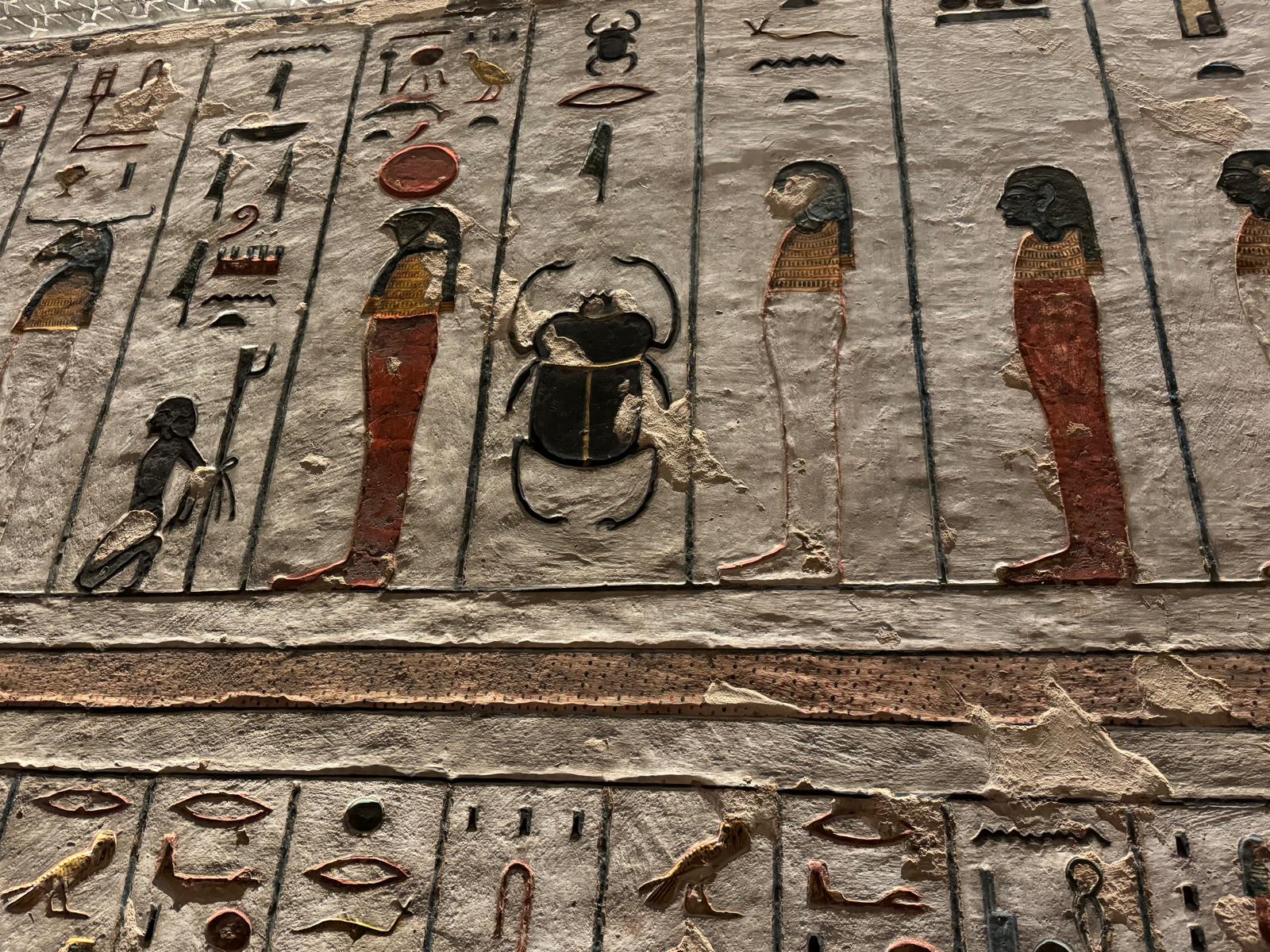
- Amun: Often shown wearing a tall crown with two feathers. He was especially important at Karnak and Thebes.
- Ra: The sun god, commonly represented with a solar disk, sometimes above a falcon's head.
- Horus: Frequently depicted with a falcon's head and associated with kingship and protection.
- Osiris: Usually shown as a mummified figure wearing the Atef crown, associated with the afterlife and resurrection.
- Isis: Often represented as a woman with a throne-shaped symbol on her head, although other forms also occur.
- Anubis: Commonly depicted with a jackal's head and connected with mummification and funerary practices.
- Hathor: Often shown with cow horns surrounding a solar disk, or with a human face and cow ears.
- Thoth: Frequently represented with the head of an ibis and associated with writing, knowledge, and wisdom.
These visual clues can help you identify the figures, but not every representation follows exactly the same pattern. Gods could have multiple forms and different symbols depending on the period and religious context.
3. Understand What Hieroglyphs Really Are
Egyptian hieroglyphs are one of the most fascinating features of temple walls. They combine signs that can represent sounds, words, and ideas. Some signs function as phonetic symbols, while others help clarify the meaning of a word.
Unlike modern alphabets, hieroglyphic writing can be arranged horizontally or vertically. It may be read from left to right or from right to left. To determine the direction, look at the faces of human and animal figures: the writing is generally read toward the direction those figures face.
You may also notice oval-shaped frames surrounding royal names. These are called cartouches. They identify the names of kings and queens and are among the most useful features for beginners to recognize.
For example, the names of Ramesses II and other rulers appear inside cartouches on temple walls. Identifying a cartouche can help you connect a particular building or decoration with the ruler responsible for commissioning it.
You do not need to learn the entire hieroglyphic system before visiting Egypt. Even recognizing royal names, common symbols, and the direction of writing can make temple visits much more rewarding.
4. Discover the Meaning Behind Offering Scenes
One of the most common scenes in Egyptian temples shows a pharaoh presenting something to a god.
The offerings might include incense, flowers, food, wine, water, precious objects, or small symbolic figures. These were not merely decorative scenes. They represented the king's duty to honor the gods and sustain the sacred relationship between the temple and the divine world.
In many scenes, the god sits or stands facing the pharaoh, who extends an offering toward the deity. Hieroglyphic inscriptions may identify the offering, describe the ritual, or record the king's titles.
Pay attention to the objects held by each figure. A staff, an ankh symbol, a scepter, or a ritual vessel may help you understand what is happening.
Temple walls frequently portray idealized rituals rather than ordinary daily events. They communicate religious and political messages about how the world should function.
5. Why Are Pharaohs Often Shown Fighting Enemies?
Another famous scene shows the pharaoh gripping the hair of defeated enemies and raising a weapon above them. This image is known as the smiting scene and appears in Egyptian royal art over many centuries.
It symbolizes the king's power to defeat chaos and protect Egypt. Although some scenes may refer to real military campaigns, the imagery also expresses an enduring religious and political idea: the ruler must preserve order against disorder.
Other walls depict chariots, bows, captured prisoners, foreign lands, and battle formations. These reliefs could celebrate royal victories and reinforce the pharaoh's authority.
A particularly impressive place to explore this imagery is Medinet Habu on Luxor's West Bank. Its extensive carved reliefs include military campaigns associated with Ramesses III.
When examining battle scenes, remember that temple art often presents the king in an idealized way. The images were designed to communicate royal power, not necessarily to provide a neutral historical record of every event.
6. Look for the Symbolism of Life, Protection, and Royal Power
Egyptian temple walls contain symbols that appear repeatedly across different periods and locations.
Some of the most recognizable include:
- Ankh: A cross-shaped symbol with a loop at the top, associated with life.
- Was scepter: A staff with a distinctive animal-like head, associated with power and authority.
- Djed pillar: A symbol associated with stability and commonly linked to Osiris.
- Eye of Horus: A protective symbol associated with healing and restoration.
- Scarab beetle: Associated with the sun, renewal, and transformation.
- Lotus flower: Often associated with regeneration and the imagery of creation.
- Winged sun disk: A protective emblem frequently found above temple entrances and doorways.
These symbols can help you recognize recurring ideas throughout Egyptian religious art. Their meanings sometimes varied according to context, so it is best to interpret them alongside the surrounding figures and inscriptions.
7. Why Are Temple Ceilings Often Blue and Covered with Stars?
Do not spend your entire visit looking at the walls. Remember to look up.
Some Egyptian temples feature ceilings painted with stars, celestial symbols, or astronomical imagery. These decorations reflect the importance of the heavens in Egyptian religious thought.
The sky was connected with divine beings, the sun's daily journey, and the cycles of renewal. Astronomical imagery could also relate to timekeeping and religious festivals.
At Dendera Temple, dedicated primarily to Hathor, visitors can explore remarkable astronomical imagery, including the famous zodiac ceiling tradition. The original zodiac relief is now preserved in the Louvre, while the temple itself remains an exceptional place to appreciate the surviving decorative program and its historical context.
Looking upward reveals another dimension of temple design: the building was not just a monument to royal power but also a representation of a sacred universe.
8. Understand the Importance of Temple Columns
Temple columns were often designed with capitals resembling lotus flowers, papyrus plants, or other forms inspired by nature.
These designs connected sacred architecture with ideas about creation, fertility, and the landscape of the Nile Valley. In some temples, the columns evoke a symbolic marsh of plants, suggesting a connection with the primeval environment from which life emerged in Egyptian creation traditions.
Karnak Temple is particularly impressive for its monumental columns. Its Great Hypostyle Hall contains enormous pillars covered with inscriptions and reliefs. Standing among them allows visitors to appreciate the scale of the architecture and the craftsmanship involved in producing it.
Look at the capitals, shafts, and bases of the columns. Notice how the decoration changes across the surfaces and how the columns create an impression of entering a sacred natural world.
9. Read a Temple from the Outside In
Many Egyptian temples follow a progression from open public areas toward increasingly restricted sacred spaces. The exact layout differs from one temple to another, but a common arrangement includes a monumental entrance, open courtyard, columned hall, and inner sanctuary.
The entrance pylon often features royal imagery and inscriptions. The courtyard provides a transition into the temple complex, while columned halls create a more enclosed and ceremonial environment.
The sanctuary at the innermost part of the temple was generally the most sacred area, housing or associated with the divine image used in religious rituals. Access was restricted, especially in comparison with the more open areas.
As you move through a temple, observe how the light, space, and decoration change. The architectural journey itself can help explain the religious purpose of the building.
Remember, however, that Egyptian temples were developed and modified over centuries. Some complexes contain additions by numerous rulers, and not every temple follows the same plan.
10. The Best Egyptian Temples for Learning to Read Ancient Walls
If you want to practice these skills during your Egyptian holiday, several temples offer excellent opportunities.
Karnak Temple, Luxor
Karnak is ideal for studying monumental columns, royal inscriptions, religious processions, and scenes associated with Amun and other deities. Its long history makes it particularly valuable for understanding how temple complexes developed over time.
Luxor Temple, Luxor
Luxor Temple offers impressive royal statues, ceremonial scenes, and reliefs connected with kingship and religious festivals. Its location in modern Luxor also makes it convenient to combine with other East Bank attractions.
Medinet Habu, Luxor
Medinet Habu is especially rewarding for visitors interested in Ramesses III, military reliefs, royal inscriptions, and the artistic presentation of power.
Edfu Temple
Dedicated to Horus, Edfu is one of the best-preserved ancient Egyptian temples. Its walls contain detailed inscriptions and ritual scenes that help visitors understand how Egyptian temple worship was represented.
Dendera Temple
Dendera is famous for its connection with Hathor, richly decorated interiors, astronomical imagery, and elaborate reliefs. It offers a fascinating opportunity to explore the relationship between architecture, mythology, and the heavens.
11. Practical Tips for Reading Temple Walls During Your Visit
You do not need to be an Egyptologist to appreciate ancient Egyptian temples. A few simple habits will help you get more out of your visit.
1. Choose one scene at a time. Instead of trying to understand an entire wall, focus on one group of figures.
2. Identify the main characters. Look for the pharaoh, the gods, their crowns, and their distinctive symbols.
3. Look for cartouches. These oval frames can help you recognize royal names.
4. Examine the objects. Offerings, scepters, and protective symbols often reveal the purpose of a scene.
5. Notice repeated images. Recurring scenes often represent established religious rituals or royal traditions.
6. Look at the architecture. Columns, gateways, courtyards, and sanctuaries all contribute to the meaning of the space.
7. Ask questions. A knowledgeable guide can explain details that are easy to miss when exploring alone.
Always follow site rules, avoid touching delicate reliefs, and never use flash photography where it is prohibited.
Conclusion: Every Temple Wall Tells a Story
Ancient Egyptian temples become far more fascinating when you understand how to interpret their walls. The pharaohs, gods, hieroglyphs, offerings, protective symbols, and astronomical scenes all contribute to a visual language that communicated religious beliefs and royal authority.
From the colossal columns of Karnak to the detailed inscriptions of Edfu and the remarkable reliefs of Medinet Habu, Egypt offers countless opportunities to explore this extraordinary artistic tradition.
The next time you visit a temple, do not simply photograph the walls and move on. Stop, observe the figures, look for familiar symbols, and consider what the ancient artists wanted to communicate.
Ready to discover the stories behind Luxor's temples? Explore Egypt with a private guided tour and experience ancient Egyptian history through its monuments, inscriptions, and remarkable works of art.
Comments
Leave a comment